PFAS (per- and polyfluoroalkyl substances) is a family of over 12,000 synthetic chemicals. They're called "forever chemicals" because the carbon-fluorine bond in PFAS is one of the strongest in organic chemistry — it doesn't break down in the environment, in water, or in your body. They accumulate over a lifetime.
The most common route of PFAS exposure in the home is through cookware. Here's what the science actually shows.
What PFAS Are in Non-Stick Cookware?
Non-stick cookware is coated with PTFE (polytetrafluoroethylene), the material marketed under the Teflon brand. PTFE itself is a PFAS compound. For decades, PTFE was manufactured using PFOA (perfluorooctanoic acid) — a PFAS compound now classified as a possible human carcinogen by the National Institute of Environmental Health Sciences.
PFOA was phased out in the US by 2015 after being linked to kidney and testicular cancer, thyroid disease, and developmental problems in children exposed in utero. But "PFOA-free" doesn't mean PFAS-free. Manufacturers replaced PFOA with other PFAS compounds — GenX, PFBS, and dozens more — that have shorter track records and less safety data.
The EPA notes that most PFAS have not been adequately studied, and that the health effects of many replacement PFAS compounds remain unknown.
How PFAS Enter Food from Cookware
There are two main pathways:
1. Surface Degradation
When non-stick coatings are scratched by metal utensils, scoured by abrasive cleaning, or overheated, they release microparticles that can be ingested with food. A 2022 study published in Science of the Total Environment found that a single scratched Teflon pan could release over 9,000 micro- and nano-plastic particles per use — along with PFAS compounds.
2. Off-Gassing at High Temperatures
PTFE is chemically stable at normal cooking temperatures. Above 500°F (260°C), it begins to break down. Above 570°F (300°C), it releases gaseous PFAS compounds. An empty non-stick pan on high heat can exceed 600°F in minutes. The resulting fumes cause "polymer fume fever" in humans and are rapidly fatal to birds, which are more sensitive to airborne toxins.
What Are the Health Effects?
The National Toxicology Program has studied PFAS extensively. Current evidence links long-chain PFAS exposure to:
- Kidney and testicular cancer
- Thyroid hormone disruption
- Immune system suppression (including reduced vaccine response)
- Elevated cholesterol
- Reproductive and developmental harm in fetuses and infants
- Ulcerative colitis
It's important to distinguish: the primary PFAS exposure route in most populations is drinking water and food packaging — not cookware. But cookware is a controllable exposure that's easy to reduce.
The "PFOA-Free" Labeling Problem
When PFOA was banned, manufacturers responded by replacing it with shorter-chain PFAS (like GenX and PFBS) while still labeling products "PFOA-free." This practice — switching from a known harmful chemical to a structurally similar but less-studied one — is called "regrettable substitution."
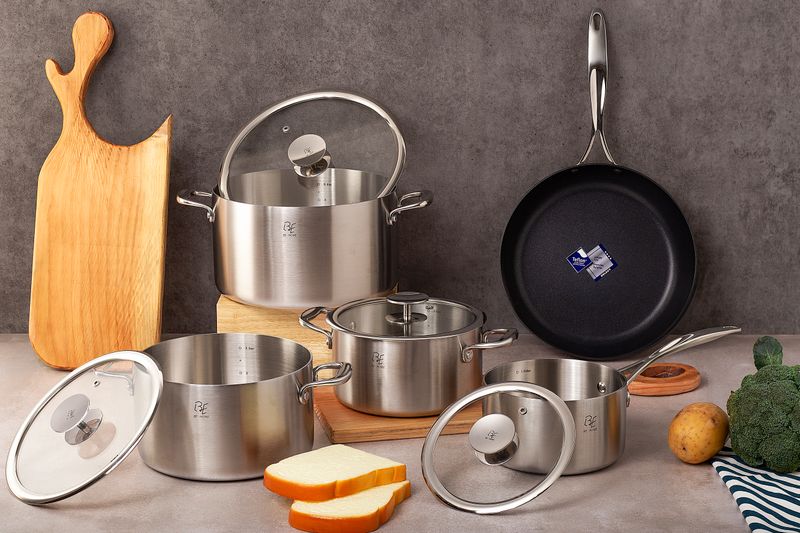
The Environmental Working Group has documented that many "PFOA-free" non-stick products still test positive for PFAS compounds. The only way to be certain your cookware is PFAS-free is to choose materials that require no synthetic coating at all: cast iron, carbon steel, or stainless steel. For verified non-stick options, see our guide to the best non-toxic cookware in 2026.
What About Ceramic Coatings?
Ceramic cookware is coated with a mineral-based (silica) surface rather than PTFE. Certified ceramic cookware like Caraway is genuinely PTFE-free and PFAS-free. However, ceramic coatings degrade faster than PTFE — typically lasting 1-3 years before losing non-stick properties. They're a safer alternative, not a permanent one.
Practical Steps to Reduce Cookware-Related PFAS Exposure
- Replace any chipped or scratched non-stick pans immediately. Degraded coatings shed particles.
- Never use non-stick pans on high heat. Keep heat to medium or below.
- Never leave a non-stick pan unattended on heat. Empty pans overheat in minutes.
- Transition to cast iron or carbon steel for high-heat cooking. These are completely inert.
- Use stainless steel for everyday cooking. With proper technique, it performs well without any coatings.
PFAS exposure from cookware is one piece of a larger picture. PFAS also enter the body through contaminated drinking water — one of the highest-volume exposure routes. Filtering your water is as important as switching your cookware.
Recommended Products
Frequently Asked Questions
Related Resources
- Hard water filtration and water quality guides Your water supply matters as much as your materials.
What are PFAS chemicals in cookware?
PFAS in cookware include PTFE (the material in Teflon coatings) and the processing chemicals used to make it, including PFOA and its replacements. PFAS are called "forever chemicals" because they don't break down in the body or environment. They've been linked to kidney cancer, thyroid disruption, and immune suppression.
Is PFOA-free the same as PFAS-free?
No. PFOA is one specific PFAS compound. "PFOA-free" cookware typically replaced PFOA with other PFAS compounds — a practice the EPA calls "regrettable substitution." Unless cookware is specifically labeled PTFE-free and certified by a third party, PFOA-free does not mean PFAS-free.
How does PFAS get into food from cookware?
PFAS from cookware can enter food through surface degradation (micro-particles from scratched or overheated coatings) and off-gassing (PTFE releasing vapors when overheated above 500°F). Acidic foods cooked in chipped non-stick pans have higher contamination potential.
What cookware has no PFAS at all?
Cast iron, carbon steel, enamel-coated cast iron, and 18/10 stainless steel contain no PFAS. Ceramic-coated cookware from certified brands like Caraway is also PFAS-free. Anything labeled "non-stick" should be treated with skepticism unless it has third-party PTFE-free certification.
Get weekly guides from ToxinFreeMaterials
No spam. Unsubscribe anytime.